

Healthy root systems
Protected roots take up water and nutrients better, especially in the dry season.
Nematicides range
Invisible to the naked eye, nematodes weaken roots and reduce yields. Protect your vegetables, bananas and pineapples from planting onwards.

The basics
Plant-parasitic nematodes are tiny worms that live in the soil and feed on roots. Root-knot nematodes (Meloidogyne) cause characteristic galls on the roots; others, such as Radopholus in banana, create lesions that weaken the anchorage of the plants.
A nematicide reduces nematode populations in the root zone. Depending on the product, it is a chemical active ingredient, an antagonistic micro-organism or a plant-based soil amendment. Nematicides are usually applied to the soil before or at planting, alongside crop rotation and the use of clean planting material.
Benefits
Protected roots take up water and nutrients better, especially in the dry season.
An antagonistic fungus and neem cake complement chemical solutions in integrated programmes.
Treatment focused on the root zone, at planting or in the nursery, where it matters.
Catalogue
Filter by crop to show the products suited to your situation.
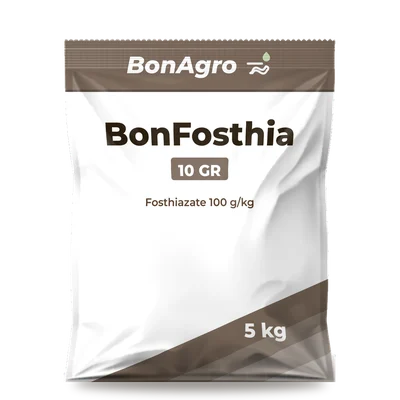 Nematicide
Fosthiazate 100 g/kg · GR
Granular nematicide incorporated before planting against root-knot, lesion and burrowing nematodes.
BonFosthia 10 GR contains 100 g/kg fosthiazate, a non-fumigant organophosphate that acts by contact on soil nematodes and systemically in young roots. It reduces nematode movement, feeding and reproduction during the critical crop establishment phase. Granules must be spread evenly and incorporated into moist soil.
Key benefits
| Crop | Targets | Rate | Timing |
|---|---|---|---|
| Tomato | Root-knot nematodes, Root-lesion nematodes | 20 – 30 kg/ha | Spread evenly, then incorporate into the top 10–15 cm of moist soil just before transplanting; one application per crop.Max. applications: 1 |
| Pepper & chilli | Root-knot nematodes, Root-lesion nematodes | 20 – 30 kg/ha | Spread evenly, then incorporate into the top 10–15 cm of moist soil just before transplanting; one application per crop.Max. applications: 1 |
| Cabbage | Root-knot nematodes | 20 – 30 kg/ha | Spread evenly, then incorporate into the top 10–15 cm of moist soil just before transplanting; one application per crop.Max. applications: 1 |
| Banana & plantain | Burrowing nematode, Root-lesion nematodes, Root-knot nematodes | 15 – 20 g/plant | Spread around the mat in a 30–50 cm ring at the start of the rainy season, then every 4–6 months; cover lightly with soil.Max. applications: 3 |
Always read the label before use.
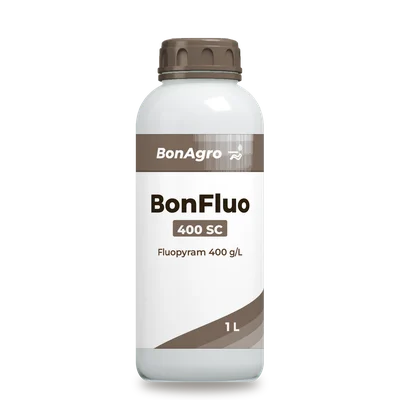 Nematicide
Fluopyram 400 g/L · SC
Low-rate SDHI nematicide applied through drip or as a drench against root-knot and lesion nematodes.
BonFluo 400 SC contains 400 g/L fluopyram, which blocks energy production in nematodes (mitochondrial complex II): they are paralysed within hours and stop feeding. Applied to the root zone by drip irrigation or localised drench, it protects roots from transplanting onwards with a very small amount of active ingredient. Fluopyram also has fungicidal activity (FRAC group 7).
Key benefits
| Crop | Targets | Rate | Timing |
|---|---|---|---|
| Tomato | Root-knot nematodes | 0.5 L/ha | Through drip irrigation or as a drench at the plant base, within 7 days of transplanting; a second application is possible 3 weeks later depending on infestation.Max. applications: 2 |
| Pepper & chilli | Root-knot nematodes | 0.5 L/ha | Through drip irrigation or as a drench at the plant base, within 7 days of transplanting; a second application is possible 3 weeks later depending on infestation.Max. applications: 2 |
| Banana & plantain | Burrowing nematode, Root-knot nematodes, Root-lesion nematodes | 0.5 – 0.75 L/ha | Directed soil spray around the mats, on moist soil, at the start of the rainy season; repeat after 6 months if needed.Max. applications: 2Spray volume: 300 L/ha |
| Pineapple | Root-knot nematodes, Root-lesion nematodes | 0.5 – 0.75 L/ha | Directed soil spray after planting, on moist soil; repeat 4–6 months later if needed.Max. applications: 2Spray volume: 300 L/ha |
Always read the label before use.
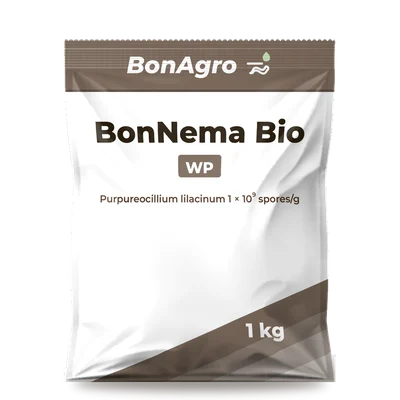 Nematicide
Biosolution
Nematicide
Biosolution
Purpureocillium lilacinum (nematophagous fungus) 1 × 10⁹ spores/g · WP
Biological nematicide based on a fungus that parasitises nematode eggs, for healthier soils in vegetables and fruit crops.
BonNema Bio WP contains spores of Purpureocillium lilacinum (syn. Paecilomyces lilacinus), a soil fungus that colonises the root zone and parasitises nematode eggs and sedentary females. It progressively reduces populations and fits into programmes combining rotation, organic matter and, where needed, chemical nematicides. Store in a cool place away from sunlight, and do not mix with fungicides.
Key benefits
| Crop | Targets | Rate | Timing |
|---|---|---|---|
| Tomato | Root-knot nematodes | 2.5 – 5 kg/ha | Mix into the nursery substrate or organic manure, then apply to the root zone at transplanting; repeat 4–6 weeks later.Max. applications: 3 |
| Pepper & chilli | Root-knot nematodes | 2.5 – 5 kg/ha | Mix into the nursery substrate or organic manure, then apply to the root zone at transplanting; repeat 4–6 weeks later.Max. applications: 3 |
| Banana & plantain | Burrowing nematode, Root-knot nematodes, Root-lesion nematodes | 10 – 20 g/plant | At planting, in the planting hole mixed with organic matter, then around the mats every 6 months.Max. applications: 2 |
| Yam | Yam nematode | 10 – 20 g/plant | At planting, in the mound around the seed yam, mixed with organic matter.Max. applications: 1 |
| Pineapple | Root-knot nematodes, Root-lesion nematodes | 2.5 – 5 kg/ha | Before or at planting, mixed with organic matter, then again 3 months later.Max. applications: 2 |
Always read the label before use.
 Nematicide
Dazomet 980 g/kg · GR
Granular soil disinfectant for nurseries and vegetable beds: nematodes, soil-borne fungi and weed seeds.
BonDazo 98 GR contains 980 g/kg dazomet which, on contact with soil moisture, releases a gas, methyl isothiocyanate, active against nematodes, the soil-borne fungi that cause damping-off, weed seeds and some soil insects. It is used before sowing or planting on tilled, moist soil covered with plastic sheeting. An airing period and a germination test are essential before sowing or transplanting.
Key benefits
| Crop | Targets | Rate | Timing |
|---|---|---|---|
| Tomato | Root-knot nematodes, Damping-off | 40 – 50 g/m² | On finely tilled, moist soil: spread, incorporate to 15–20 cm, water and cover with plastic sheeting for 7–12 days; air for 7–14 days and run a germination test (cress or lettuce) before sowing or transplanting.Max. applications: 1 |
| Pepper & chilli | Root-knot nematodes, Damping-off | 40 – 50 g/m² | On finely tilled, moist soil: spread, incorporate to 15–20 cm, water and cover with plastic sheeting for 7–12 days; air for 7–14 days and run a germination test (cress or lettuce) before sowing or transplanting.Max. applications: 1 |
| Cabbage | Root-knot nematodes, Damping-off | 40 – 50 g/m² | On finely tilled, moist soil: spread, incorporate to 15–20 cm, water and cover with plastic sheeting for 7–12 days; air for 7–14 days and run a germination test (cress or lettuce) before sowing or transplanting.Max. applications: 1 |
| Onion | Root-knot nematodes, Damping-off | 40 – 50 g/m² | On finely tilled, moist soil: spread, incorporate to 15–20 cm, water and cover with plastic sheeting for 7–12 days; air for 7–14 days and run a germination test (cress or lettuce) before sowing or transplanting.Max. applications: 1 |
Always read the label before use.
 Nematicide
Biosolution
Nematicide
Biosolution
Neem seed cake (Azadirachta indica) 950 g/kg + Azadirachtin 1 g/kg · GR
Neem cake granules containing azadirachtin that suppress nematodes and termites while adding organic matter to the soil.
BonNeem Sol GR is granulated neem seed cake (Azadirachta indica) that gradually releases limonoids, including azadirachtin, with nematostatic and repellent effects. It lowers nematode and termite pressure while supplying organic matter and nutrients that boost soil biological activity. Apply as a base dressing before sowing or transplanting, or placed in the planting hole.
Key benefits
| Crop | Targets | Rate | Timing |
|---|---|---|---|
| Tomato | Root-knot nematodes, Termites | 250 – 500 kg/ha | Work into the soil 7–15 days before transplanting, broadcast or along the planting rows; a second application during the crop is possible.Max. applications: 2 |
| Pepper & chilli | Root-knot nematodes, Termites | 250 – 500 kg/ha | Work into the soil 7–15 days before transplanting, broadcast or along the planting rows; a second application during the crop is possible.Max. applications: 2 |
| Onion | Root-knot nematodes | 250 – 500 kg/ha | Work into the soil 7–15 days before transplanting, broadcast or along the planting rows; a second application during the crop is possible.Max. applications: 2 |
| Cabbage | Root-knot nematodes, Termites | 250 – 500 kg/ha | Work into the soil 7–15 days before transplanting, broadcast or along the planting rows; a second application during the crop is possible.Max. applications: 2 |
| Yam | Yam nematode, Termites | 50 – 100 g/plant | At planting, in the mound or planting hole, around the seed yam.Max. applications: 1 |
Always read the label before use.
No product in this range is listed for this crop. Contact our advisers for an alternative.
Talk to an adviserAlways read the label before use. Product information is given for guidance only; the label of the product authorised in your country always prevails.
Selection guide
Find your field situation to identify the right BonAgro solution, then check the authorised uses on the label.
| Field situation | Timing | BonAgro solution |
|---|---|---|
| Root-knot nematodes on tomato, pepper and other vegetables | Soil application just before or at transplanting, incorporated | BonFosthia 10 GRFosthiazate 100 g/kg |
| Nematodes in tomato, pepper, banana and pineapple, as a liquid application | Through drip irrigation, as a drench or as a directed soil spray | BonFluo 400 SCFluopyram 400 g/L |
| Biological or integrated programmes (vegetables, banana, yam, pineapple) | At planting, mixed with organic matter, then as maintenance treatments | BonNema Bio WPPurpureocillium lilacinum (nematophagous fungus) 1 × 10⁹ spores/g |
| Nursery bed sterilisation (root-knot nematodes, damping-off fungi) | Before sowing, with a compulsory waiting period before planting | BonDazo 98 GRDazomet 980 g/kg |
| Improving the soil and reducing nematode pressure (vegetables, yam) | Incorporated into the soil before transplanting or at planting | BonNeem Sol GRNeem seed cake (Azadirachta indica) 950 g/kg + Azadirachtin 1 g/kg |
| Burrowing and root-knot nematodes of banana and plantain | Around the stools at the start of the rains, as on the label | BonFosthia 10 GRFosthiazate 100 g/kg |
Good practice
Confirm that nematodes are present: dig up a few declining plants and check the roots for galls, lesions or few fine roots.
Use clean planting material raised in nematode-free substrate.
Rotate with less susceptible crops such as cereals to reduce soil populations.
Apply granular nematicides to moist soil and incorporate them into the root zone.
For biological products, add organic matter and keep the soil moist.
Strictly respect the waiting period before planting after a soil fumigant.
Sustainability
Nematodes become resistant less often than insects, but treatments can lose efficacy after repeated use on the same field, because soil micro-organisms break some active ingredients down faster. An integrated strategy remains the key.
The mode-of-action group is shown on each product's technical sheet.
FAQ
Our advisers will point you to the right solution for your crop.
Talk to an adviserThe symptoms look like water stress: stunted plants, wilting in the heat of the day and yellowing, often in patches. Dig up a few plants: galls or lesions on the roots confirm the diagnosis.
Usually before or at planting, to protect the young roots. Some products allow maintenance applications during the crop cycle: follow the label instructions.
They act more gradually than chemical products and give their best results when used preventively, in moist soil rich in organic matter, as part of an integrated programme.
Soil fumigants release gases that are toxic to all plants. A ventilation period, given on the label, is essential before sowing or planting; a germination test shows whether any residue remains.
Our other ranges
Clean fields from sowing to harvest
7 products
View the range — HerbicidesProtect your harvest against insect pests
7 products
View the range — InsecticidesHealthy crops, even in the rainy season
6 products
View the range — FungicidesSteer growth, add value to your harvest
7 products
View the range — Growth regulatorsOur advisers will recommend the right product, rate and timing for your field.