

Preventive protection
Applied before infection, fungicides keep leaves and fruits healthy through risk periods.
Fungicides range
Contact, systemic or combined fungicides: protect leaves, fruits and pods against diseases favoured by tropical humidity.

The basics
A fungicide is a product that protects plants against the fungi and related organisms that cause diseases such as rots, downy mildews, rusts, leaf spots and powdery mildews. In hot, humid climates these diseases spread very quickly and can destroy a large part of the harvest.
Contact fungicides (copper, mancozeb, sulphur) form a protective barrier on the surface of treated plant parts: they are applied before infection and must be renewed after heavy rain or new growth. Systemic fungicides enter the plant and also protect growing tissues.
Benefits
Applied before infection, fungicides keep leaves and fruits healthy through risk periods.
Complementary modes of action protect plant surfaces and growing tissues.
Copper, mancozeb and sulphur carry a low resistance risk and secure your programmes.
Catalogue
Filter by crop to show the products suited to your situation.
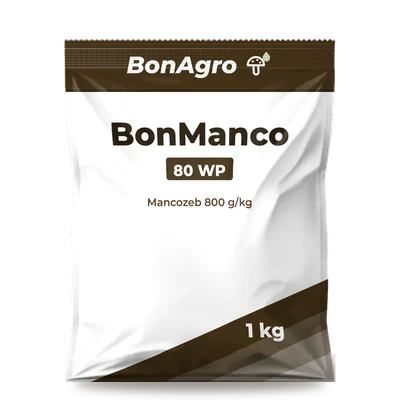 Fungicide
Mancozeb 800 g/kg · WP
Broad-spectrum multi-site contact fungicide, the preventive backbone of vegetable and food-crop programmes.
BonManco 80 WP contains 800 g/kg mancozeb, a dithiocarbamate that stops spore germination by acting on many sites at once. This multi-site mode of action carries a very low resistance risk, making it the ideal partner for systemic fungicides. Applied before infection and renewed regularly, it protects leaves and fruit against late blight, downy mildew, Alternaria, anthracnose and leaf spots.
Key benefits
| Crop | Targets | Rate | Timing |
|---|---|---|---|
| Tomato | Late blight, Alternaria blights | 2 – 2.5 kg/ha | Preventively from establishment after transplanting, then every 7 days in the rainy season and every 10–14 days in the dry season.Max. applications: 6Spray volume: 300 L/ha |
| Pepper & chilli | Anthracnose, Leaf spots (Cercospora) | 2 – 2.5 kg/ha | Preventively from flowering, every 7–10 days in humid weather.Max. applications: 6Spray volume: 300 L/ha |
| Onion | Alternaria blights, Downy mildew | 2 – 2.5 kg/ha | Preventively from the 4–5 leaf stage, every 7–10 days; add a wetter for good adhesion on the waxy foliage.Max. applications: 5Spray volume: 300 L/ha |
| Cabbage | Downy mildew, Alternaria blights | 2 – 2.5 kg/ha | In the nursery and after transplanting, preventively every 7–10 days in humid weather.Max. applications: 4Spray volume: 300 L/ha |
| Groundnut | Leaf spots (Cercospora) | 1.5 – 2 kg/ha | From 30–35 days after sowing, then every 10–14 days; 3–4 sprays per season.Max. applications: 4Spray volume: 200 L/ha |
| Yam | Anthracnose | 2 – 2.5 kg/ha | Preventively once regular rains have set in, every 14 days during the wet period.Max. applications: 4Spray volume: 200 L/ha |
| Mango | Anthracnose | 1.5 – 2 kg/ha | From panicle emergence to fruit set, every 10–14 days; observe the pre-harvest interval.Max. applications: 4Spray volume: 300 L/ha |
| Banana & plantain | Black Sigatoka | 1.5 – 2.5 kg/ha | Preventively every 10–15 days in the rainy season, alternating with a systemic fungicide; sanitary de-leafing remains essential.Max. applications: 8Spray volume: 150 L/ha |
Always read the label before use.
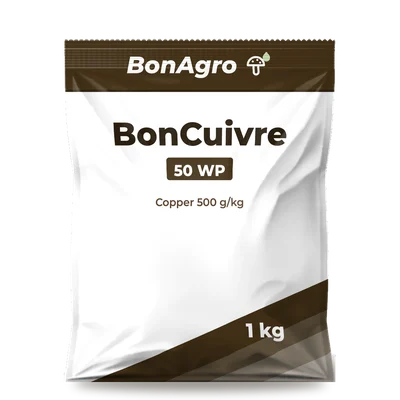 Fungicide
Copper (as copper hydroxide) 500 g/kg · WP
Copper hydroxide fungicide and bactericide against cocoa black pod, bacterial diseases and many fungal diseases.
BonCuivre 50 WP contains 500 g/kg metallic copper as copper hydroxide, a highly reactive form that rapidly releases copper ions on treated surfaces. These ions prevent the germination of fungal and oomycete spores and slow down bacterial multiplication. Apply preventively and renew after heavy rain, keeping to the recommended rates to limit copper build-up in soils.
Key benefits
| Crop | Targets | Rate | Timing |
|---|---|---|---|
| Cocoa | Cocoa black pod | 0.75 – 1 kg/ha | From the appearance of young pods at the start of the rainy season, every 3–4 weeks, targeting the pods (about 55–75 g per 15 L knapsack); remove diseased pods.Max. applications: 6Spray volume: 200 L/ha |
| Coffee | Coffee leaf rust | 1.5 – 2 kg/ha | Preventively at the start of the rainy season, then every 3–4 weeks depending on disease pressure.Max. applications: 4Spray volume: 300 L/ha |
| Tomato | Bacterial spot & canker, Late blight | 1.5 – 2 kg/ha | Preventively every 7–10 days in warm, humid weather; do not exceed the rate to avoid scorching young plants.Max. applications: 6Spray volume: 300 L/ha |
| Pepper & chilli | Bacterial spot & canker, Anthracnose | 1.5 – 2 kg/ha | Preventively every 7–10 days in warm, humid weather; do not exceed the rate to avoid scorching young plants.Max. applications: 6Spray volume: 300 L/ha |
| Citrus | Bacterial spot & canker, Leaf spots (Cercospora) | 1 – 1.5 kg/ha | On new flushes and young fruit, at the start and in the middle of the rainy season; 2–4 sprays per year.Max. applications: 4Spray volume: 300 L/ha |
| Mango | Anthracnose, Bacterial spot & canker | 1 – 1.5 kg/ha | From flowering to fruit set and on new flushes, every 14 days in humid weather.Max. applications: 4Spray volume: 300 L/ha |
Always read the label before use.
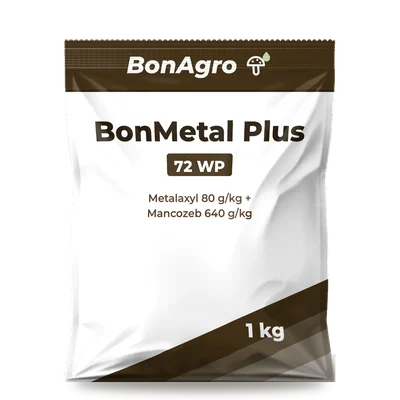 Fungicide
Metalaxyl 80 g/kg + Mancozeb 640 g/kg · WP
Systemic plus contact combination against late blight, downy mildew and damping-off, with early curative action.
BonMetal Plus 72 WP combines metalaxyl, rapidly absorbed and carried to young tissue, with mancozeb, which forms a contact barrier on the leaf surface. Particularly active on oomycetes (Phytophthora, Pythium, Peronospora), it halts recent infections and protects new growth. To preserve metalaxyl's effectiveness, use it preventively and limit the number of applications per season.
Key benefits
| Crop | Targets | Rate | Timing |
|---|---|---|---|
| Tomato | Late blight, Alternaria blights | 2 – 2.5 kg/ha | As soon as the weather favours late blight (rain, fog, cool nights), every 10–14 days; no more than 3 applications per season, alternating with a contact fungicide.Max. applications: 3Spray volume: 300 L/ha |
| Tomato | Damping-off | 2 – 2.5 g/L | Nursery: drench the substrate at sowing and again 10–15 days later, using 2–3 L of mix per m².Max. applications: 2 |
| Pepper & chilli | Damping-off | 2 – 2.5 g/L | Nursery: drench the substrate at sowing and again 10–15 days later, using 2–3 L of mix per m².Max. applications: 2 |
| Onion | Downy mildew | 2 – 2.5 kg/ha | Preventively or at the first symptoms, in cool, humid weather, every 10–14 days; no more than 3 applications per season.Max. applications: 3Spray volume: 300 L/ha |
| Cabbage | Downy mildew | 2 – 2.5 kg/ha | Preventively or at the first symptoms, in cool, humid weather, every 10–14 days; no more than 3 applications per season.Max. applications: 3Spray volume: 300 L/ha |
Always read the label before use.
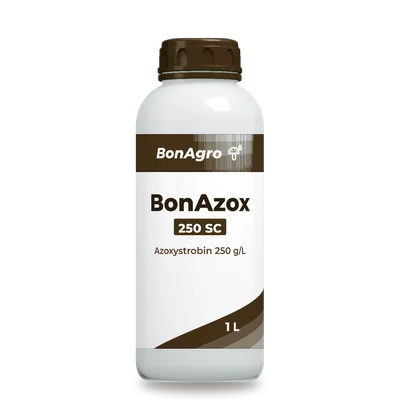 Fungicide
Azoxystrobin 250 g/L · SC
Broad-spectrum systemic strobilurin against rice blast, leaf spots, rusts, powdery mildew and anthracnose.
BonAzox 250 SC contains 250 g/L azoxystrobin, a strobilurin that blocks fungal respiration and strongly inhibits spore germination. Its translaminar and xylem mobility protects both leaf surfaces and new growth. FRAC group 11 carries a high resistance risk: limit the number of applications and alternate or mix with a fungicide from another group.
Key benefits
| Crop | Targets | Rate | Timing |
|---|---|---|---|
| Rice | Rice blast | 0.5 – 0.75 L/ha | Preventively at booting, then at heading under high neck-blast pressure.Max. applications: 2Spray volume: 250 L/ha |
| Groundnut | Leaf spots (Cercospora) | 0.5 – 0.75 L/ha | At the first spots (30–40 days after sowing), then 14–21 days later, alternating with a fungicide from another group.Max. applications: 2Spray volume: 200 L/ha |
| Soybean | Asian soybean rust, Leaf spots (Cercospora) | 0.3 – 0.5 L/ha | At the first rust pustules, or preventively at flowering (R1–R3) in high-risk areas; repeat after 14–21 days.Max. applications: 2Spray volume: 200 L/ha |
| Tomato | Alternaria blights, Powdery mildew | 0.5 – 0.8 L/ha | Preventively or at the first spots, alternating with a contact fungicide; 10–14 day interval.Max. applications: 2Spray volume: 300 L/ha |
| Onion | Alternaria blights, Downy mildew | 0.6 – 0.8 L/ha | At the first purple blotch lesions or when weather favours downy mildew, alternating with a contact fungicide.Max. applications: 2Spray volume: 300 L/ha |
| Mango | Anthracnose, Powdery mildew | 0.5 – 0.75 L/ha | From flower-bud break to fruit set, alternating with a fungicide from another group.Max. applications: 2Spray volume: 300 L/ha |
| Cashew | Anthracnose, Powdery mildew | 0.5 – 0.75 L/ha | At early flowering and again 2–3 weeks later, alternating with sulphur or a triazole.Max. applications: 2Spray volume: 300 L/ha |
| Banana & plantain | Black Sigatoka | 0.4 L/ha | In strict rotation with fungicides from other groups, according to disease development; sanitary removal of necrotic leaves remains essential.Max. applications: 3Spray volume: 150 L/ha |
Always read the label before use.
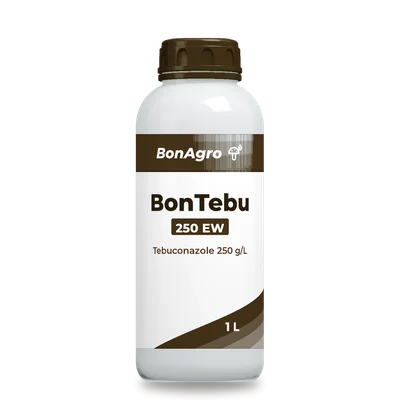 Fungicide
Tebuconazole 250 g/L · EW
Systemic triazole against rusts, black Sigatoka, leaf spots, powdery mildew and rice blast.
BonTebu 250 EW contains 250 g/L tebuconazole, a triazole sterol biosynthesis inhibitor that quickly penetrates plant tissue and moves towards young growth. It halts the development of fungi that are already established, giving curative action on recent infections. Its oil-in-water emulsion (EW) formulation reduces solvent content.
Key benefits
| Crop | Targets | Rate | Timing |
|---|---|---|---|
| Banana & plantain | Black Sigatoka | 0.4 L/ha | In strict rotation with fungicides from other groups, according to disease development; sanitary removal of necrotic leaves remains essential.Max. applications: 4Spray volume: 150 L/ha |
| Groundnut | Leaf spots (Cercospora) | 0.5 – 0.75 L/ha | At the first spots, then every 14–21 days; 2–3 applications per season.Max. applications: 3Spray volume: 200 L/ha |
| Rice | Rice blast, Leaf spots (Cercospora) | 0.5 – 0.75 L/ha | At booting and heading when disease pressure warrants it, alternating with a fungicide from another group.Max. applications: 2Spray volume: 250 L/ha |
| Soybean | Asian soybean rust, Leaf spots (Cercospora) | 0.4 – 0.5 L/ha | At the first rust pustules, or preventively at flowering (R1–R3) in high-risk areas; repeat after 14–21 days.Max. applications: 2Spray volume: 200 L/ha |
| Coffee | Coffee leaf rust | 0.5 – 0.75 L/ha | At the start of the rainy season, at the first orange lesions, then 4–6 weeks later.Max. applications: 2Spray volume: 300 L/ha |
| Cashew | Powdery mildew, Anthracnose | 0.5 – 0.75 L/ha | At panicle emergence and again 2–3 weeks later, alternating with sulphur or a strobilurin.Max. applications: 2Spray volume: 300 L/ha |
Always read the label before use.
 Fungicide
Biosolution
Fungicide
Biosolution
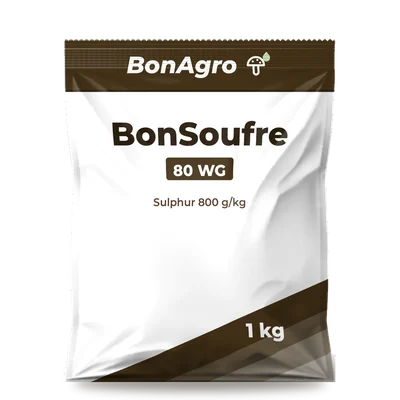
Sulphur 800 g/kg · WG
Water-dispersible sulphur granules against powdery mildew and mites; an active substance accepted in organic farming.
BonSoufre 80 WG contains 800 g/kg micronised sulphur as granules that disperse quickly in water without dust. Sulphur acts by contact and in the vapour phase on powdery mildew fungi and keeps mite populations in check. Do not apply in very hot weather (above 30–32 °C) or within three weeks of an oil spray, to avoid leaf scorch.
Key benefits
| Crop | Targets | Rate | Timing |
|---|---|---|---|
| Mango | Powdery mildew | 2 – 2.5 kg/ha | From panicle emergence to fruit set, every 10–14 days, during the cool hours of the day.Max. applications: 3Spray volume: 300 L/ha |
| Cashew | Powdery mildew | 2 – 2.5 kg/ha | From panicle emergence, then every 2–3 weeks during flowering, in the cool hours of the day.Max. applications: 3Spray volume: 300 L/ha |
| Tomato | Powdery mildew, Mites | 2 – 3 kg/ha | At the first signs of powdery mildew or mites, every 10–14 days, outside the hottest hours of the day.Max. applications: 4Spray volume: 300 L/ha |
| Pepper & chilli | Powdery mildew, Mites | 2 – 3 kg/ha | At the first signs of powdery mildew or mites, every 10–14 days, outside the hottest hours of the day.Max. applications: 4Spray volume: 300 L/ha |
| Citrus | Mites | 2 – 3 kg/ha | As soon as mites appear on leaves and fruit, avoiding hot spells; cover the foliage thoroughly.Max. applications: 3Spray volume: 300 L/ha |
Always read the label before use.
No product in this range is listed for this crop. Contact our advisers for an alternative.
Talk to an adviserAlways read the label before use. Product information is given for guidance only; the label of the product authorised in your country always prevails.
Selection guide
Find your field situation to identify the right BonAgro solution, then check the authorised uses on the label.
| Field situation | Timing | BonAgro solution |
|---|---|---|
| Cocoa black pod (Phytophthora) | Preventive sprays through the rainy season, renewed as on the label | BonCuivre 50 WPCopper (as copper hydroxide) 500 g/kg |
| Late and early blight of tomato and other vegetables | Preventive, as soon as the weather turns humid | BonManco 80 WPMancozeb 800 g/kg |
| Downy mildew and late blight of tomato, onion and vegetables under high pressure | At the start of the risk period, alternating with a contact fungicide | BonMetal Plus 72 WPMetalaxyl 80 g/kg + Mancozeb 640 g/kg |
| Rice blast and leaf spots of food crops | Preventive, from booting to heading | BonAzox 250 SCAzoxystrobin 250 g/L |
| Black Sigatoka of banana, rusts and leaf spots (groundnut, soybean, coffee) | At the first symptoms or as part of a preventive programme | BonTebu 250 EWTebuconazole 250 g/L |
| Powdery mildew of mango and cashew, powdery mildew and mites in vegetables | At the start of flowering, then according to disease pressure | BonSoufre 80 WGSulphur 800 g/kg |
| Bacterial and foliar diseases of vegetables and coffee | Preventive, alongside sanitation measures | BonCuivre 50 WPCopper (as copper hydroxide) 500 g/kg |
Good practice
Spray preventively: a fungicide protects better than it cures.
Renew contact fungicides after heavy rain or a flush of growth, keeping to the interval on the label.
Combine sprays with sanitation: removing diseased parts, opening up plantations, crop rotation.
Wet all leaves and fruits thoroughly, adjusting the spray volume to the canopy.
Limit the number of systemic fungicide applications and alternate them with multi-site products.
Sustainability
Single-site fungicides (strobilurins, triazoles, phenylamides) carry a medium to high risk of resistance. Mixing or alternating them with multi-site fungicides (copper, mancozeb, sulphur) is the best way to keep them effective.
The mode-of-action group is shown on each product's technical sheet.
FAQ
Our advisers will point you to the right solution for your crop.
Talk to an adviserNo: most fungicides, especially contact products, work best preventively. Start protection when conditions favour the disease (rain, high humidity), as on the label.
Heavy rain can wash off a contact fungicide. Respect the product's rainfast period and renew protection if needed, within the maximum number of applications allowed.
A contact fungicide stays on the surface of the plant and stops spores from germinating. A systemic fungicide enters the plant and moves through its tissues: it also protects new growth, but carries a higher resistance risk.
Yes, copper fungicides are widely used to protect pods preventively against black pod. Follow the rate, spray interval and precautions on the label, and combine them with regular removal of diseased pods.
No: sulphur must not be applied in hot weather or used with certain oils, whether mixed or applied a few days apart. Always check the label and do a compatibility test before any tank mix.
Our other ranges
Clean fields from sowing to harvest
7 products
View the range — HerbicidesProtect your harvest against insect pests
7 products
View the range — InsecticidesHealthy roots for vigorous plants
5 products
View the range — NematicidesSteer growth, add value to your harvest
7 products
View the range — Growth regulatorsOur advisers will recommend the right product, rate and timing for your field.