

A competition-free start
Crops establish in clean soil and make better use of water and fertiliser.
Herbicides range
Total or selective, pre- or post-emergence: control weeds when they compete most with your crops.

The basics
A herbicide is a product that kills weeds or prevents them from emerging. Weeds compete with the crop for water, light and nutrients, and can harbour pests and diseases: left uncontrolled, they often cause heavy yield losses, especially in the first weeks of the crop.
Non-selective herbicides kill all vegetation (land clearing before planting, inter-row weed control), while selective herbicides remove weeds without harming the crop. Depending on timing, they act pre-emergence, before the weeds come up, or post-emergence, on weeds that have already emerged.
Benefits
Crops establish in clean soil and make better use of water and fertiliser.
Well-planned chemical weed control cuts labour needs at peak periods.
Grasses, broadleaves or sedges: each product matches a specific weed flora and crop.
Catalogue
Filter by crop to show the products suited to your situation.
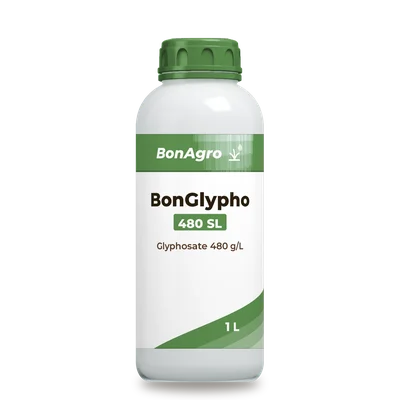 Herbicide
Glyphosate (isopropylamine salt) 480 g/L · SL
Systemic non-selective herbicide for land preparation and plantation upkeep, including Imperata control.
BonGlypho 480 SL contains 480 g/L glyphosate isopropylamine salt, equivalent to 360 g/L glyphosate acid. Absorbed through the leaves, it moves down to roots, rhizomes and tubers, killing annual and perennial weeds. With no residual soil activity, sowing or planting can follow shortly after treatment.
Key benefits
| Crop | Targets | Rate | Timing |
|---|---|---|---|
| Maize | Annual grasses, Broadleaf weeds, Perennial grasses (Imperata), Sedges (nutsedges) | 2 – 6 L/ha | Before sowing, on emerged, actively growing weeds: 2–3 L/ha on annuals, 4–6 L/ha on perennials; wait 7 days before any tillage.Max. applications: 1Spray volume: 150 L/ha |
| Rice | Rice weeds, Annual grasses, Perennial grasses (Imperata), Sedges (nutsedges) | 2 – 6 L/ha | Field preparation before ploughing, puddling or direct seeding, on actively growing weeds: 2–3 L/ha on annuals, up to 6 L/ha on perennials.Max. applications: 1Spray volume: 150 L/ha |
| Cotton | Annual grasses, Broadleaf weeds, Perennial grasses (Imperata), Sedges (nutsedges) | 2 – 6 L/ha | Before sowing, on emerged, actively growing weeds: 2–3 L/ha on annuals, 4–6 L/ha on perennials; wait 7 days before any tillage.Max. applications: 1Spray volume: 150 L/ha |
| Oil palm | Annual grasses, Broadleaf weeds, Perennial grasses (Imperata) | 2 – 6 L/ha | Directed spray on palm circles and inter-rows, keeping off the foliage: 2–3 L/ha on annuals, 4–6 L/ha on Imperata.Max. applications: 3Spray volume: 150 L/ha |
| Rubber | Annual grasses, Broadleaf weeds, Perennial grasses (Imperata) | 2 – 6 L/ha | Immature phase: weeding of planting lines with a directed spray, avoiding green bark and foliage; 2–6 L/ha depending on the weed flora.Max. applications: 3Spray volume: 150 L/ha |
| Cocoa | Annual grasses, Broadleaf weeds | 2 – 4 L/ha | Young plantings: directed spray under a protective shield, never reaching foliage or green bark; 2–4 L/ha.Max. applications: 3Spray volume: 150 L/ha |
| Coffee | Annual grasses, Broadleaf weeds | 2 – 4 L/ha | Young plantings: directed spray under a protective shield, never reaching foliage or green bark; 2–4 L/ha.Max. applications: 3Spray volume: 150 L/ha |
| Cashew | Annual grasses, Broadleaf weeds, Perennial grasses (Imperata) | 2 – 6 L/ha | Under-canopy weeding and firebreak upkeep at the end of the rainy season, on weeds that are still green; 2–6 L/ha depending on the weed flora.Max. applications: 2Spray volume: 150 L/ha |
| Mango | Annual grasses, Broadleaf weeds, Perennial grasses (Imperata) | 2 – 6 L/ha | Directed under-canopy weeding, keeping off foliage, fruit and young bark; 2–6 L/ha depending on the weed flora.Max. applications: 3Spray volume: 150 L/ha |
| Citrus | Annual grasses, Broadleaf weeds, Perennial grasses (Imperata) | 2 – 6 L/ha | Directed under-canopy weeding, keeping off foliage, fruit and young bark; 2–6 L/ha depending on the weed flora.Max. applications: 3Spray volume: 150 L/ha |
| Banana & plantain | Annual grasses, Broadleaf weeds | 2 – 4 L/ha | Between rows and around mats with a directed spray, keeping off leaves and suckers; 2–4 L/ha.Max. applications: 3Spray volume: 150 L/ha |
| Pineapple | Annual grasses, Broadleaf weeds, Perennial grasses (Imperata), Sedges (nutsedges) | 3 – 6 L/ha | Land preparation before planting (clearing fallow or crop residues); 3–6 L/ha depending on the weed flora.Max. applications: 1Spray volume: 150 L/ha |
Always read the label before use.
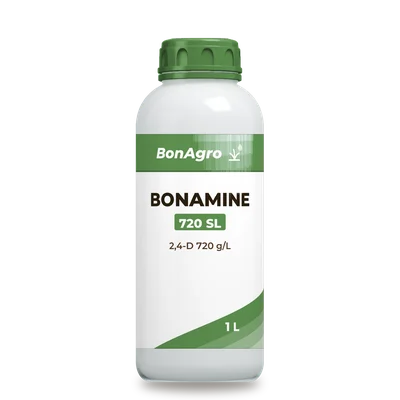 Herbicide
2,4-D (dimethylamine salt) 720 g/L · SL
Selective cereal herbicide against broadleaf weeds and sedges, cost-effective and fast-acting.
BONAMINE 720 SL is a synthetic auxin based on 2,4-D dimethylamine salt (720 g/L). Taken up by leaves and roots, it disrupts the growth of susceptible broadleaf weeds and sedges, while cereals treated at the right stage are unaffected. Avoid any drift onto cotton, legumes and vegetables, which are highly sensitive.
Key benefits
| Crop | Targets | Rate | Timing |
|---|---|---|---|
| Maize | Broadleaf weeds, Sedges (nutsedges) | 1 – 1.5 L/ha | Post-emergence, from the 3- to 6-leaf stage of maize, on young weeds; later, use a directed spray between rows.Max. applications: 1Spray volume: 200 L/ha |
| Rice | Rice weeds, Broadleaf weeds, Sedges (nutsedges) | 1 – 1.5 L/ha | At full tillering, about 25–40 days after sowing or transplanting; do not spray once stem elongation has started.Max. applications: 1Spray volume: 200 L/ha |
| Sorghum | Broadleaf weeds | 0.75 – 1 L/ha | From the 4- to 6-leaf stage, before stem elongation; later, directed spray only.Max. applications: 1Spray volume: 200 L/ha |
| Millet | Broadleaf weeds | 0.75 – 1 L/ha | From the 4-leaf stage to early tillering, before stem elongation.Max. applications: 1Spray volume: 200 L/ha |
| Oil palm | Broadleaf weeds, Sedges (nutsedges) | 1 – 2 L/ha | Inter-row upkeep with a directed spray against broadleaf weeds, keeping off palm foliage; avoid drift onto nearby sensitive crops.Max. applications: 2Spray volume: 200 L/ha |
Always read the label before use.
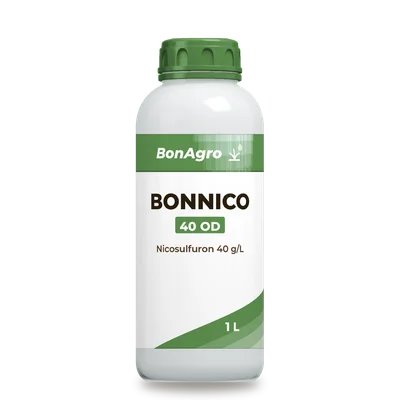 Herbicide
Nicosulfuron 40 g/L · OD
Post-emergence maize herbicide against annual grasses and many broadleaf weeds, including itchgrass (Rottboellia).
BONNICO 40 OD combines nicosulfuron, an ALS-inhibiting sulfonylurea, with an oil-dispersion formulation that improves leaf uptake. Weeds stop growing within hours, then yellow and die within 2–3 weeks, while maize rapidly breaks down the active ingredient. Do not mix it with an organophosphate insecticide, and seek advice before treating sweet corn or seed-production lines.
Key benefits
| Crop | Targets | Rate | Timing |
|---|---|---|---|
| Maize | Annual grasses, Broadleaf weeds | 1 – 1.5 L/ha | Post-emergence, from the 2- to 8-leaf stage of maize, on grasses from 2 leaves to early tillering; 1.5 L/ha on itchgrass or heavy infestations.Max. applications: 1Spray volume: 200 L/ha |
Always read the label before use.
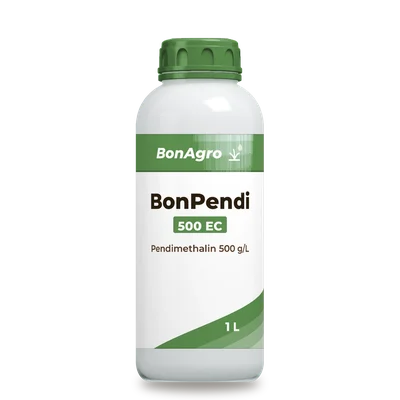 Herbicide
Pendimethalin 500 g/L · EC
Broad-spectrum pre-emergence herbicide that prevents annual grasses and broadleaf weeds from establishing for several weeks.
BonPendi 500 EC contains 500 g/L pendimethalin, a dinitroaniline that blocks cell division in weed seedlings as they emerge. Applied just after sowing on a moist, well-prepared seedbed, it forms a residual barrier lasting 6–8 weeks depending on soil and rainfall. It does not control weeds that have already emerged, so follow up with post-emergence weed control where needed.
Key benefits
| Crop | Targets | Rate | Timing |
|---|---|---|---|
| Cotton | Annual grasses, Broadleaf weeds | 2.5 – 3 L/ha | Pre-emergence, within 48 hours of sowing, on a moist, fine, clod-free seedbed.Max. applications: 1Spray volume: 250 L/ha |
| Maize | Annual grasses, Broadleaf weeds | 2.5 – 3 L/ha | Pre-emergence, just after sowing (within 3 days), before maize and weeds emerge.Max. applications: 1Spray volume: 250 L/ha |
| Rice | Annual grasses, Broadleaf weeds | 2 – 3 L/ha | Upland or dry-seeded rice: pre-emergence, 1–3 days after sowing, with seed well covered; do not use in nurseries.Max. applications: 1Spray volume: 250 L/ha |
| Groundnut | Annual grasses, Broadleaf weeds | 2 – 3 L/ha | Pre-emergence, just after sowing (within 2 days), on a moist, fine, clod-free seedbed.Max. applications: 1Spray volume: 250 L/ha |
| Cowpea | Annual grasses, Broadleaf weeds | 2 – 3 L/ha | Pre-emergence, just after sowing (within 2 days), on a moist, fine, clod-free seedbed.Max. applications: 1Spray volume: 250 L/ha |
| Soybean | Annual grasses, Broadleaf weeds | 2 – 3 L/ha | Pre-emergence, just after sowing (within 2 days), on a moist, fine, clod-free seedbed.Max. applications: 1Spray volume: 250 L/ha |
| Sesame | Annual grasses, Broadleaf weeds | 1.5 – 2 L/ha | Pre-emergence, immediately after an even sowing, with seed covered by 2–3 cm of soil.Max. applications: 1Spray volume: 250 L/ha |
| Cassava | Annual grasses, Broadleaf weeds | 2.5 – 3 L/ha | Just after planting the cuttings, before weeds emerge.Max. applications: 1Spray volume: 250 L/ha |
| Onion | Annual grasses, Broadleaf weeds | 2 – 2.5 L/ha | Transplanted onion: on clean, moist soil in the days following transplanting.Max. applications: 1Spray volume: 250 L/ha |
| Tomato | Annual grasses, Broadleaf weeds | 2 – 2.5 L/ha | Before transplanting on prepared soil, or just after on clean soil, keeping off the foliage.Max. applications: 1Spray volume: 250 L/ha |
Always read the label before use.
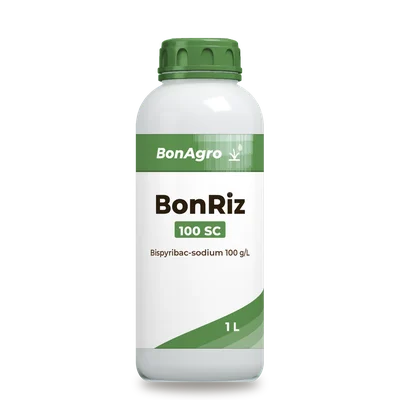 Herbicide
Bispyribac-sodium 100 g/L · SC
Broad-spectrum post-emergence rice herbicide: barnyard grass (Echinochloa), sedges and broadleaf weeds in a single pass.
BonRiz 100 SC contains 100 g/L bispyribac-sodium, an ALS inhibitor taken up by leaves and roots. Suitable for irrigated, lowland and upland rice, direct-seeded or transplanted, it controls grasses, sedges and broadleaf weeds up to the 5-leaf stage. Re-flooding the field 1–3 days after spraying limits new weed flushes.
Key benefits
| Crop | Targets | Rate | Timing |
|---|---|---|---|
| Rice | Rice weeds, Annual grasses, Sedges (nutsedges), Broadleaf weeds | 200 – 300 mL/ha | Post-emergence, 15–25 days after sowing or transplanting, weeds at the 2–5 leaf stage; drain the field before spraying and re-flood it 1–3 days later.Max. applications: 1Spray volume: 250 L/ha |
Always read the label before use.
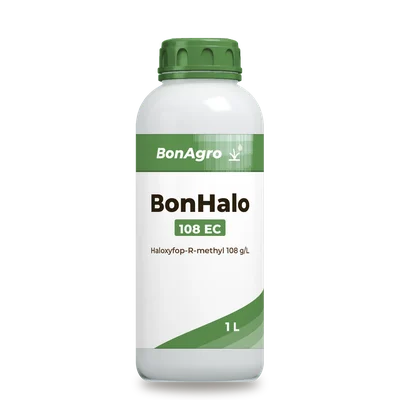 Herbicide
Haloxyfop-R-methyl 108 g/L · EC
Post-emergence grass killer for cotton, legumes, sesame and onion, effective on annual and perennial grasses.
BonHalo 108 EC contains 108 g/L haloxyfop-R-methyl, an ACCase inhibitor (fop family) rapidly absorbed by the leaves and carried to the growing points of grasses. It is safe on broadleaf crops and has no effect on sedges. Grasses turn yellow within 7–10 days and die within 2–3 weeks.
Key benefits
| Crop | Targets | Rate | Timing |
|---|---|---|---|
| Cotton | Annual grasses, Perennial grasses (Imperata) | 0.4 – 1 L/ha | 0.4–0.5 L/ha on annual grasses (2 leaves to early tillering); 0.8–1 L/ha on actively growing perennial grasses (20–30 cm high).Max. applications: 1Spray volume: 200 L/ha |
| Soybean | Annual grasses, Perennial grasses (Imperata) | 0.4 – 1 L/ha | 0.4–0.5 L/ha on annual grasses (2 leaves to early tillering); 0.8–1 L/ha on actively growing perennial grasses (20–30 cm high).Max. applications: 1Spray volume: 200 L/ha |
| Groundnut | Annual grasses, Perennial grasses (Imperata) | 0.4 – 1 L/ha | 0.4–0.5 L/ha on annual grasses (2 leaves to early tillering); 0.8–1 L/ha on actively growing perennial grasses (20–30 cm high).Max. applications: 1Spray volume: 200 L/ha |
| Cowpea | Annual grasses, Perennial grasses (Imperata) | 0.4 – 1 L/ha | 0.4–0.5 L/ha on annual grasses (2 leaves to early tillering); 0.8–1 L/ha on actively growing perennial grasses (20–30 cm high).Max. applications: 1Spray volume: 200 L/ha |
| Sesame | Annual grasses, Perennial grasses (Imperata) | 0.4 – 1 L/ha | 0.4–0.5 L/ha on annual grasses (2 leaves to early tillering); 0.8–1 L/ha on actively growing perennial grasses (20–30 cm high).Max. applications: 1Spray volume: 200 L/ha |
| Onion | Annual grasses, Perennial grasses (Imperata) | 0.4 – 1 L/ha | 0.4–0.5 L/ha on annual grasses (2 leaves to early tillering); 0.8–1 L/ha on actively growing perennial grasses (20–30 cm high).Max. applications: 1Spray volume: 200 L/ha |
Always read the label before use.
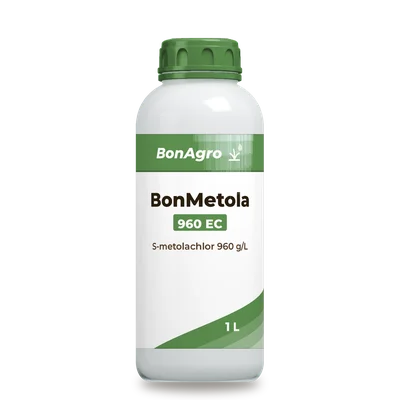 Herbicide
S-metolachlor 960 g/L · EC
Pre-emergence herbicide against annual grasses, yellow nutsedge and some broadleaf weeds in maize, cotton, legumes and tomato.
BonMetola 960 EC contains 960 g/L S-metolachlor, the active isomer of metolachlor, which inhibits very-long-chain fatty acid synthesis. Taken up by the shoots and young roots of germinating weeds, it prevents their emergence for 6–10 weeks. 10–15 mm of rain or irrigation in the days after application ensures activation.
Key benefits
| Crop | Targets | Rate | Timing |
|---|---|---|---|
| Maize | Annual grasses, Sedges (nutsedges), Broadleaf weeds | 1 – 1.5 L/ha | Pre-emergence, within 3 days of sowing: 1 L/ha on sandy soils, 1.5 L/ha on clay or organic-rich soils.Max. applications: 1Spray volume: 250 L/ha |
| Cotton | Annual grasses, Sedges (nutsedges), Broadleaf weeds | 1 – 1.5 L/ha | Pre-emergence, within 3 days of sowing: 1 L/ha on sandy soils, 1.5 L/ha on clay or organic-rich soils.Max. applications: 1Spray volume: 250 L/ha |
| Groundnut | Annual grasses, Sedges (nutsedges) | 1 – 1.5 L/ha | Pre-emergence, within 3 days of sowing: 1 L/ha on sandy soils, 1.5 L/ha on clay or organic-rich soils.Max. applications: 1Spray volume: 250 L/ha |
| Soybean | Annual grasses, Sedges (nutsedges) | 1 – 1.5 L/ha | Pre-emergence, within 3 days of sowing: 1 L/ha on sandy soils, 1.5 L/ha on clay or organic-rich soils.Max. applications: 1Spray volume: 250 L/ha |
| Cowpea | Annual grasses, Sedges (nutsedges) | 1 – 1.25 L/ha | Pre-emergence, within 2 days of sowing; use the lower rate on sandy soils.Max. applications: 1Spray volume: 250 L/ha |
| Cassava | Annual grasses, Sedges (nutsedges), Broadleaf weeds | 1 – 1.5 L/ha | Just after planting the cuttings, before weeds emerge.Max. applications: 1Spray volume: 250 L/ha |
| Tomato | Annual grasses, Sedges (nutsedges) | 1 – 1.25 L/ha | Before transplanting, on prepared, moist soil; transplant without disturbing the treated soil layer.Max. applications: 1Spray volume: 250 L/ha |
Always read the label before use.
No product in this range is listed for this crop. Contact our advisers for an alternative.
Talk to an adviserAlways read the label before use. Product information is given for guidance only; the label of the product authorised in your country always prevails.
Selection guide
Find your field situation to identify the right BonAgro solution, then check the authorised uses on the label.
| Field situation | Timing | BonAgro solution |
|---|---|---|
| Land clearing before planting, emerged annual and perennial weeds (spear grass, couch grass…) | On actively growing weeds, before sowing or planting | BonGlypho 480 SLGlyphosate (isopropylamine salt) 480 g/L |
| Inter-row weed control in plantations (cocoa, oil palm, rubber, citrus, cashew) | Directed spray, keeping off the crop's leaves and green bark | BonGlypho 480 SLGlyphosate (isopropylamine salt) 480 g/L |
| Broadleaf weeds and sedges in rice, maize, sorghum or millet | Post-emergence on young weeds, at the crop stage given on the label | BONAMINE 720 SL2,4-D (dimethylamine salt) 720 g/L |
| Annual grasses and broadleaf weeds in maize | Post-emergence, maize at 2–8 leaves, on young weeds | BONNICO 40 ODNicosulfuron 40 g/L |
| Preventing annual grasses and broadleaf weeds in cotton, maize, groundnut or soybean | Pre-emergence, just after sowing, on moist, well-prepared soil | BonPendi 500 ECPendimethalin 500 g/L |
| Annual grasses in maize, cotton or groundnut | Pre-emergence, just after sowing | BonMetola 960 ECS-metolachlor 960 g/L |
| Barnyard grass (Echinochloa), sedges and broadleaf weeds in rice | Post-emergence, 15–25 days after sowing or transplanting, following the water management on the label | BonRiz 100 SCBispyribac-sodium 100 g/L |
| Grasses in broadleaf crops (cotton, soybean, groundnut, cowpea, onion) | Post-emergence, from young grasses up to early tillering | BonHalo 108 ECHaloxyfop-R-methyl 108 g/L |
Good practice
Identify the dominant weeds (grasses, broadleaves, sedges) before choosing a herbicide.
Apply pre-emergence herbicides to moist soil, free of clods and debris, just after sowing.
Post-emergence, treat young, actively growing weeds, never during drought stress.
Use a flat-fan nozzle and clean water: muddy water reduces the efficacy of active ingredients such as glyphosate.
Prevent drift onto sensitive neighbouring crops by spraying in light wind.
Rinse the sprayer thoroughly after using a hormone herbicide (2,4-D) before treating another crop.
Sustainability
Repeated use of herbicides with the same mode of action selects resistant weeds, as seen in many parts of the world with glyphosate and ALS inhibitors. The HRAC groups shown on our technical sheets make it easy to rotate and combine modes of action.
The mode-of-action group is shown on each product's technical sheet.
FAQ
Our advisers will point you to the right solution for your crop.
Talk to an adviserA pre-emergence herbicide is applied to the soil before weeds emerge and stops them from establishing. A post-emergence herbicide is applied to weeds that have already emerged; it works best on young, actively growing weeds.
It depends on the active ingredient and formulation: the rainfast period is given on the label and on each product's technical sheet. Our spray window checker helps you check conditions before you spray.
No: glyphosate is a non-selective herbicide that also kills the crop. In tree crops it is only used as a directed spray on the weeds, without touching the crop's leaves or green bark, as allowed on the label.
The most common causes are soil that is too dry or poorly prepared, late application (weeds already up), a rate unsuited to the soil type or heavy rain just after spraying. An adviser can help you work out what happened.
Spray in light wind with a suitable nozzle and moderate pressure, and leave an unsprayed buffer at the field edge. Cotton, tomato and cowpea are very sensitive to hormone herbicides: rinse the sprayer thoroughly after use.
Our other ranges
Protect your harvest against insect pests
7 products
View the range — InsecticidesHealthy crops, even in the rainy season
6 products
View the range — FungicidesHealthy roots for vigorous plants
5 products
View the range — NematicidesSteer growth, add value to your harvest
7 products
View the range — Growth regulatorsOur advisers will recommend the right product, rate and timing for your field.