

Clearly defined targets
Each product is recommended for specific pests and crops, at the label rate.
Insecticides range
Caterpillars, sucking pests, leaf miners, fruit flies, mites: targeted solutions to build into an integrated pest management strategy.

The basics
An insecticide is a product that protects crops against insect pests. Depending on the active ingredient, it works by contact, by ingestion or systemically, and targets a specific group of pests (caterpillars, sucking insects…) or a broader spectrum.
Acaricides, which control mites, and baits, which attract insects to a small amount of product, complete the range. The right choice depends on the pest, its stage of development and the crop stage: scouting the field is the first step of any treatment.
Benefits
Each product is recommended for specific pests and crops, at the label rate.
Several IRAC groups to rotate treatments and keep them effective over time.
Baits and targeted active ingredients to limit the impact on beneficial insects where possible.
Catalogue
Filter by crop to show the products suited to your situation.
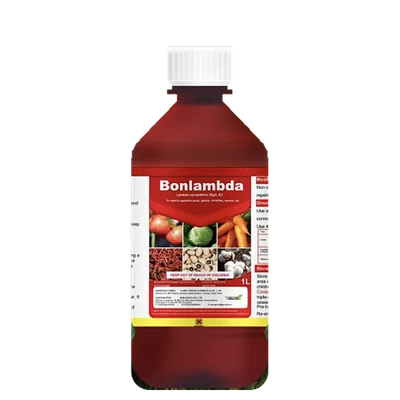 Insecticide
Lambda-cyhalothrin 25 g/L · EC
Fast-acting pyrethroid against caterpillars, bugs, borers and thrips in field crops, cashew, coffee and vegetables.
BonLambda 25 EC contains 25 g/L lambda-cyhalothrin, a pyrethroid that acts on the insect nervous system by contact and ingestion. Its knockdown effect stops feeding damage within hours and its repellent action adds to the protection. To preserve its efficacy, rotate it with insecticides from other IRAC groups and do not use it against whiteflies or mites.
Key benefits
| Crop | Targets | Rate | Timing |
|---|---|---|---|
| Cotton | African bollworm, Leaf-eating caterpillars | 0.6 – 0.8 L/ha | From flowering to boll formation, as soon as the action threshold is reached, alternating with other IRAC groups.Max. applications: 3Spray volume: 150 L/ha |
| Maize | Stem borers | 0.4 – 0.6 L/ha | At the first borer damage in the whorl (4- to 8-leaf stage), directing the spray into the whorl.Max. applications: 2Spray volume: 200 L/ha |
| Cowpea | Pod borers, Thrips | 0.6 – 0.8 L/ha | At flower-bud stage, then at flowering and pod formation; 2–3 sprays 7–10 days apart.Max. applications: 3Spray volume: 200 L/ha |
| Sesame | Leaf-eating caterpillars | 0.4 – 0.6 L/ha | As soon as caterpillars appear in the young shoots; repeat after 10–14 days if needed.Max. applications: 2Spray volume: 200 L/ha |
| Cashew | Cashew bugs | 0.75 – 1 L/ha | At flushing and early flowering, at the first feeding lesions on young shoots; spray early in the morning or late in the day, outside bee foraging hours.Max. applications: 2Spray volume: 200 L/ha |
| Coffee | Coffee berry borer | 0.6 – 0.8 L/ha | During the female flight period, 90–120 days after the main flowering, when 2–5% of berries are bored; alongside sanitary harvesting and trapping.Max. applications: 2Spray volume: 200 L/ha |
| Tomato | African bollworm, Leaf-eating caterpillars | 0.4 – 0.6 L/ha | At the first eggs or young larvae on flowers and fruit; observe the pre-harvest interval stated on the label.Max. applications: 2Spray volume: 300 L/ha |
Always read the label before use.
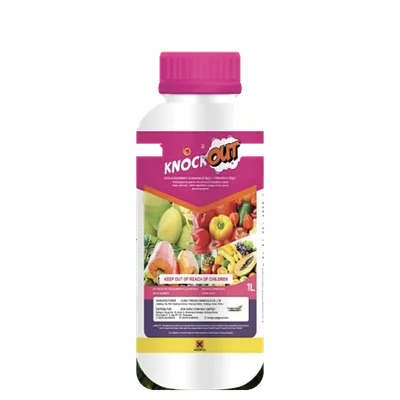 Insecticide
Acetamiprid 30 g/L + Bifenthrin 20 g/L · EC
Acetamiprid + bifenthrin combination against cocoa mirids, with fast knockdown and systemic protection of new shoots.
KNOCKOUT 50 EC combines 30 g/L acetamiprid, a systemic neonicotinoid, with 20 g/L bifenthrin, a pyrethroid with fast knockdown and good residual activity. Mirids are hit on contact and when feeding on treated tissue, including shoots formed after spraying thanks to the systemic movement of acetamiprid. Apply it during the mirid build-up period, within the cocoa farm protection programme, alternating with products from other IRAC groups.
Key benefits
| Crop | Targets | Rate | Timing |
|---|---|---|---|
| Cocoa | Cocoa mirids (capsids) | 0.75 – 1 L/ha | During the mirid build-up period (from July or August to January depending on the region), 2–4 rounds 4 weeks apart; spray the trunk, branches and pods.Max. applications: 4Spray volume: 150 L/ha |
Always read the label before use.
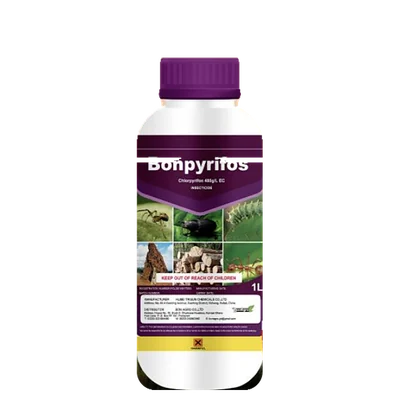 Insecticide
Chlorpyrifos 480 g/L · EC
Broad-spectrum organophosphate insecticide based on chlorpyrifos against borers, caterpillars, aphids and jassids.
BONPYRIFOS 480 EC contains 480 g/L chlorpyrifos. It acts by contact, ingestion and vapour on a broad range of pests: maize and rice stem borers, caterpillars, aphids and jassids. Spray at the first signs of damage, respecting the pre-harvest interval and the precautions on the label, and alternate with other insecticide groups.
Key benefits
| Crop | Targets | Rate | Timing |
|---|---|---|---|
| Maize | Stem borers, Fall armyworm | 1 – 1.5 L/ha | At the first damage on young plants, directing the spray into the whorl; repeat if the infestation persists.Max. applications: 2Spray volume: 200 L/ha |
| Rice | Stem borers | 1 – 1.5 L/ha | At tillering and stem elongation, as soon as dead hearts appear.Max. applications: 2Spray volume: 200 L/ha |
| Cotton | African bollworm, Aphids, Jassids (leafhoppers) | 1 – 1.5 L/ha | According to the action thresholds, alternating insecticide groups through the season.Max. applications: 3Spray volume: 200 L/ha |
| Cabbage | Leaf-eating caterpillars, Aphids | 1 L/ha | As soon as pests appear, covering both sides of the leaves well; respect the pre-harvest interval on the label.Max. applications: 2Spray volume: 300 L/ha |
Always read the label before use.
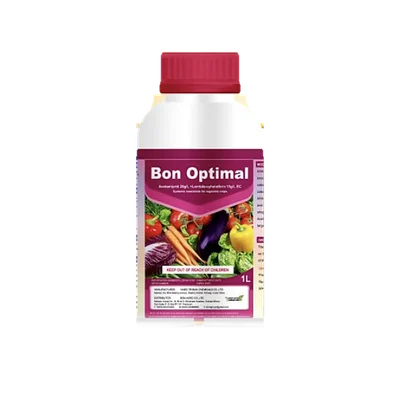 Insecticide
Acetamiprid 20 g/L + Lambda-cyhalothrin 15 g/L · EC
Systemic insecticide for vegetable crops combining acetamiprid and lambda-cyhalothrin against sucking pests and caterpillars.
BON OPTIMAL 35 EC combines 20 g/L acetamiprid, a systemic that also protects new growth, with 15 g/L lambda-cyhalothrin, which acts quickly by contact. It controls aphids, whiteflies, thrips, jassids and caterpillars on vegetable crops. Respect the pre-harvest interval on the label and spray outside bee foraging hours.
Key benefits
| Crop | Targets | Rate | Timing |
|---|---|---|---|
| Tomato | Whiteflies, Aphids, Leaf-eating caterpillars | 0.75 – 1 L/ha | As soon as pests appear, covering both sides of the leaves well; respect the pre-harvest interval on the label.Max. applications: 2Spray volume: 300 L/ha |
| Pepper & chilli | Aphids, Thrips, Jassids (leafhoppers) | 0.75 – 1 L/ha | As soon as pests appear, covering both sides of the leaves well; respect the pre-harvest interval on the label.Max. applications: 2Spray volume: 300 L/ha |
| Cabbage | Aphids, Leaf-eating caterpillars | 0.75 – 1 L/ha | As soon as pests appear, covering both sides of the leaves well; respect the pre-harvest interval on the label.Max. applications: 2Spray volume: 300 L/ha |
| Onion | Thrips | 0.75 – 1 L/ha | As soon as pests appear, covering both sides of the leaves well; respect the pre-harvest interval on the label.Max. applications: 2Spray volume: 300 L/ha |
Always read the label before use.
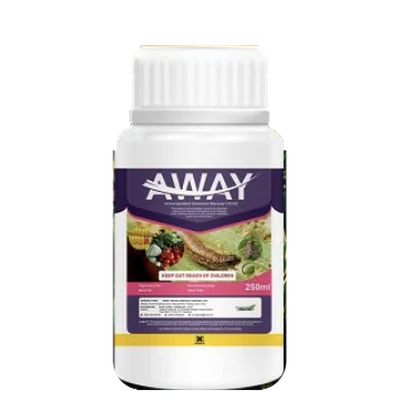 Insecticide
Emamectin benzoate 19 g/L · EC
Emamectin benzoate insecticide against caterpillars: fall armyworm in maize, tomato leaf miner and diamondback moth.
AWAY 1.9% EC contains 19 g/L emamectin benzoate. Absorbed into the leaves, it reaches the caterpillars feeding on them, including leaf miners in their galleries, and the larvae stop feeding within hours. It is used at a low rate on maize, tomato and cabbage, preferably on young larvae, alternating with other modes of action.
Key benefits
| Crop | Targets | Rate | Timing |
|---|---|---|---|
| Maize | Fall armyworm | 0.4 – 0.6 L/ha | At the first damage on young plants, directing the spray into the whorl; repeat if the infestation persists.Max. applications: 2Spray volume: 200 L/ha |
| Tomato | Tomato leafminer (Tuta), Leaf-eating caterpillars | 0.4 – 0.6 L/ha | At the first leaf mines or fruit holes, alternating with another mode of action.Max. applications: 2Spray volume: 300 L/ha |
| Cabbage | Diamondback moth, Leaf-eating caterpillars | 0.4 – 0.6 L/ha | As soon as pests appear, covering both sides of the leaves well; respect the pre-harvest interval on the label.Max. applications: 2Spray volume: 300 L/ha |
Always read the label before use.
No product in this range is listed for this crop. Contact our advisers for an alternative.
Talk to an adviserAlways read the label before use. Product information is given for guidance only; the label of the product authorised in your country always prevails.
Selection guide
Find your field situation to identify the right BonAgro solution, then check the authorised uses on the label.
| Field situation | Timing | BonAgro solution |
|---|---|---|
| Mixed pests needing fast action (caterpillars, beetles, bugs) | On pests present, outside bee foraging hours | BonLambda 25 ECLambda-cyhalothrin 25 g/L |
| Cocoa mirids | During the recommended spraying rounds, from July–August to January depending on the region | KNOCKOUT 50 ECAcetamiprid 30 g/L + Bifenthrin 20 g/L |
| Caterpillars: fall armyworm in maize, tomato leaf miner, diamondback moth | On young larvae, at the first signs of damage | AWAY 1.9% ECEmamectin benzoate 19 g/L |
| Vegetable crops: aphids, whiteflies, thrips, jassids and caterpillars | As soon as pests appear, outside bee foraging hours | BON OPTIMAL 35 ECAcetamiprid 20 g/L + Lambda-cyhalothrin 15 g/L |
| Maize and rice stem borers, cotton caterpillars and sucking pests | At the first signs of damage, respecting the pre-harvest interval | BONPYRIFOS 480 ECChlorpyrifos 480 g/L |
Good practice
Scout your fields regularly and spray according to recommended thresholds rather than by routine.
Target young larvae: older caterpillars are harder to control and have already caused damage.
Spray early in the morning or late in the afternoon, when temperatures are moderate and bees are less active.
Ensure good coverage, including the underside of leaves for sucking pests.
Respect the pre-harvest interval and the maximum number of applications on the label.
Sustainability
Pests with short life cycles and large populations, such as whiteflies, cotton bollworms and fall armyworm, quickly become resistant when the same mode of action is used again and again. IRAC groups make it possible to plan rotations.
The mode-of-action group is shown on each product's technical sheet.
FAQ
Our advisers will point you to the right solution for your crop.
Talk to an adviserCheck plants across the whole field and compare the damage or pest numbers with the thresholds recommended by extension services. Spraying without scouting is costly and encourages resistance.
Cooler conditions limit droplet evaporation, the wind is often lighter and bees are less active. Many pests, such as caterpillars, are also more exposed at those times.
Only if both labels allow it and after a compatibility test. A mixture does not replace rotating modes of action. If in doubt, ask our technical team.
First check the pest identification, the rate, the spray quality and the weather. If the problem persists, switch to another IRAC group and let our advisers know.
Avoid spraying flowering crops during foraging hours, follow the bee-related instructions on the label and warn neighbouring beekeepers before spraying.
Our other ranges
Clean fields from sowing to harvest
13 products
View the range — HerbicidesHealthy crops, even in the rainy season
2 products
View the range — FungicidesOur advisers will recommend the right product, rate and timing for your field.